
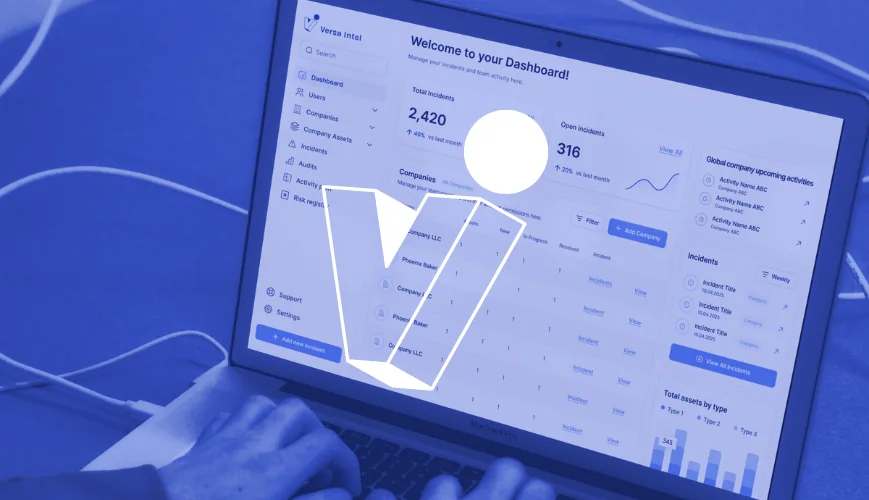
NIS2 and NKDL compliance
Who Latvia’s National Cybersecurity Law and NIS2 apply to, what the obligations are — and how to implement them so they genuinely strengthen your security.
Latvia’s National Cybersecurity Law (NKDL) entered into force on 1 September 2024 and transposes the EU NIS2 Directive (2022/2555) into Latvian law. Compared with the previous rules, it covers far more sectors and organisations — many of which have to implement cybersecurity requirements for the first time.
Cybersecurity is no longer just an IT matter. It is a management obligation with specific requirements, supervision and accountability.
Who the NKDL applies to
The law applies to essential and important entities, as well as to critical information and communication technology (ICT) infrastructure. Which group an organisation belongs to depends on its sector and size.
- Highly critical sectors: energy, transport, banking, financial market infrastructure, health, drinking water, waste water, digital infrastructure, ICT service management, public administration and space.
- Other critical sectors: postal and courier services, waste management, chemicals, food production and distribution, manufacturing (for example medical devices, computers and electronics, machinery, vehicles), digital providers and research.
- Size: usually medium-sized and large companies — from 50 employees or with turnover above EUR 10 million. Some entities, such as electronic communications and trust service providers or public administration bodies, may be included regardless of size.
Essential and important entities are supervised by the National Cyber Security Centre (under the Ministry of Defence), while critical ICT infrastructure is the responsibility of the Constitution Protection Bureau.
This is a rough guide based on the NIS2 criteria, not a legal opinion. Your final status is determined by the law and the National Cyber Security Centre.
Key obligations
- RegistrationThe organisation must determine its status and register with the National Cyber Security Centre.
- Cybersecurity managerA person responsible for cybersecurity must be appointed and the supervisory authority informed.
- Risk management and minimum requirementsCybersecurity management measures must be implemented in line with Cabinet of Ministers Regulation No. 397 of 25 June 2025, “Minimum Cybersecurity Requirements” — policies, risk assessment, access control, backups, supply-chain security and more.
- Incident reportingSignificant cyber incidents must be reported to CERT.LV within the set deadlines.
- Management accountabilityThe organisation’s management must approve and oversee cybersecurity measures and can be held accountable for failing to comply.
- Inspections and auditThe supervisory authority may carry out inspections and require a cybersecurity audit. Regulation No. 397 also sets requirements for cybersecurity auditors.
Incident reporting deadlines
The NIS2 Directive sets out three-stage reporting of significant incidents:
This means the process for detecting, assessing and reporting incidents must be ready before an incident — there is no time to build it during a crisis.
Penalties
The NIS2 Directive requires maximum fines of at least:
Even so, the biggest risk is usually not the fine but the incident itself — downtime, data loss and reputational damage.
How VersaIntel helps
We don’t just help you prepare documents — we implement the requirements so that they genuinely strengthen your security:
- Determining your statusWe assess whether and how the law applies to your organisation.
- Compliance assessmentWe compare your current state with the NKDL and Regulation No. 397 and prepare a prioritised action plan.
- Policies and risk managementWe develop policies and a risk management process and, if needed, provide a cybersecurity manager as a service (CISOaaS).
- Technical measuresWe implement IT infrastructure protection, secure backups and 24/7 monitoring (SOC).
- Incident processWe set up the incident detection and reporting process and help you when an incident happens.
- Audit and upkeepWe carry out the cybersecurity audit — our specialists are qualified auditors under Regulation No. 397 — and with Versa GRC help you stay compliant day to day.
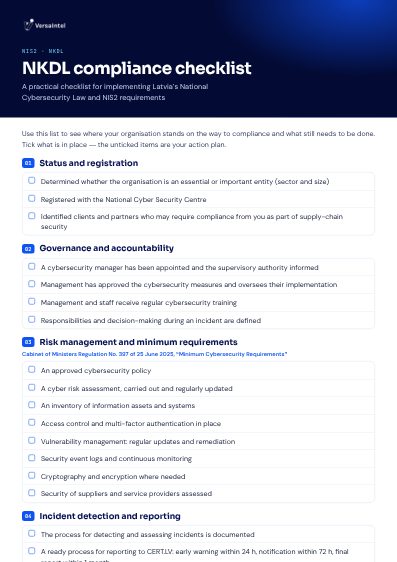
NKDL compliance checklist
A practical checklist for implementing Latvia’s National Cybersecurity Law and NIS2 requirements. Sections:
- Status and registration
- Governance and accountability
- Risk management and minimum requirements
- Incident detection and reporting
- Business continuity
- Inspections and audit
Not sure whether the law applies to you, or what still needs to be done? Book a consultation — we will assess your status and set out clear next steps.
Book a consultation

What your organisation gets
Frequently asked questions about NIS2 and the NKDL
01Does the NKDL apply to small companies?
Usually not — the law mainly applies to medium-sized and large companies in specific sectors. Exceptions include electronic communications and trust service providers, DNS and domain registries, public administration bodies and sole providers of an essential service. A small company may also face the requirements indirectly — if its clients are in scope and require a secure supply chain.
02What is the difference between essential and important entities?
Essential entities are usually large organisations in highly critical sectors and are subject to stricter supervision and higher potential fines. Important entities are the other organisations in scope. Both must implement cybersecurity management measures and report significant incidents.
03How quickly must a cyber incident be reported?
The NIS2 Directive requires an early warning within 24 hours, a notification with an initial assessment within 72 hours and a final report within one month. In Latvia, reports are made to CERT.LV.
04Does ISO 27001 certification mean NKDL compliance?
Not automatically. An ISO/IEC 27001 information security management system is a good foundation and covers much of what is required, but the NKDL and Regulation No. 397 also have specific requirements — such as registration, a cybersecurity manager and incident reporting. A compliance assessment shows what still needs to be added.
05Can VersaIntel carry out a cybersecurity audit?
Yes. VersaIntel’s specialists are qualified cybersecurity auditors under Cabinet of Ministers Regulation No. 397 of 25 June 2025, “Minimum Cybersecurity Requirements”, and VersaIntel is included in the Ministry of Defence’s list of cybersecurity auditors.
06Where do we start?
With determining your status and a compliance assessment. Book a consultation — we will assess whether and how the law applies to you and prepare a prioritised action plan.
Full portfolio of cybersecurity services

Cybersecurity management (CISOaaS)
Chief Information Security Officer as a service: cyber risk management, security policies, ISO 27001, NIS2 and NKDL compliance.
Learn more 03
Cybersecurity audit
A cybersecurity audit identifies vulnerabilities, assesses cyber risks and delivers prioritised security improvements based on international methodologies.
Learn more 04
Security Operations Center (SOC 24/7/365)
Versa SOC — 24/7/365 cybersecurity monitoring, threat intelligence and incident response.
Learn more 05IT platform security
Secure IT platforms from the ground up: secure architecture and configuration of servers, cloud platforms, networks and Microsoft environments, plus business continuity.
Learn more 06
Cyber incident investigation
Cyber incident forensics (DFIR): an evidence-based understanding of what happened, how and with what impact — and clear next steps.
Learn more 07
Microsoft 365 services for businesses
Microsoft 365 licensing, implementation, configuration, Defender security and maintenance — from a Microsoft partner.
Learn more 08
IT infrastructure security
Managed 24/7 threat protection: endpoint protection, EDR and a SOC in one system that spots attacks early and stops them before they affect the business.
Learn more 09
Data backup and recovery
Backups you can actually recover from: a secure 3-2-1 architecture, automated backups, monitoring and regular recovery testing.
Learn more 010
Versa GRC — compliance platform
Versa GRC: centralised management of risks, incidents, assets and compliance in line with NIS2, ISO/IEC 27001 and NIST.
Learn moreWe will help you
Write to us with your requirements, and our representative will contact you as soon as possible.
