
For quite some time now, cybersecurity threats have not been limited to attacks on companies or government institutions that have thought about IT security solutions in advance. More and more often, the victims of cyberattackers are private individuals who lack knowledge of the most common traps used to obtain personal data and defraud people of money.
To expose fraudulent campaigns, we will publish a series of articles, “On the Trail of Fraudulent Campaigns” — about the traps most commonly used in fraudulent campaigns in Latvia and around the world, and about what each of us can do to protect ourselves and our personal data proactively.
What is smishing?
Smishing is a fraudulent activity aimed at obtaining personal data — such as e-mail addresses, passwords and system recovery phrases — and/or stealing a person’s money. Fraudsters often start the attack with an SMS that appears to come from a well-known company or government institution. The message often states facts that alarm the recipient and make the victim hurry to open the fraudulent link.
“You have received a court summons” — analysis of a smishing campaign
Attackers send messages that appear to come from recognisable organisations or companies and exploit people’s trust to their advantage.
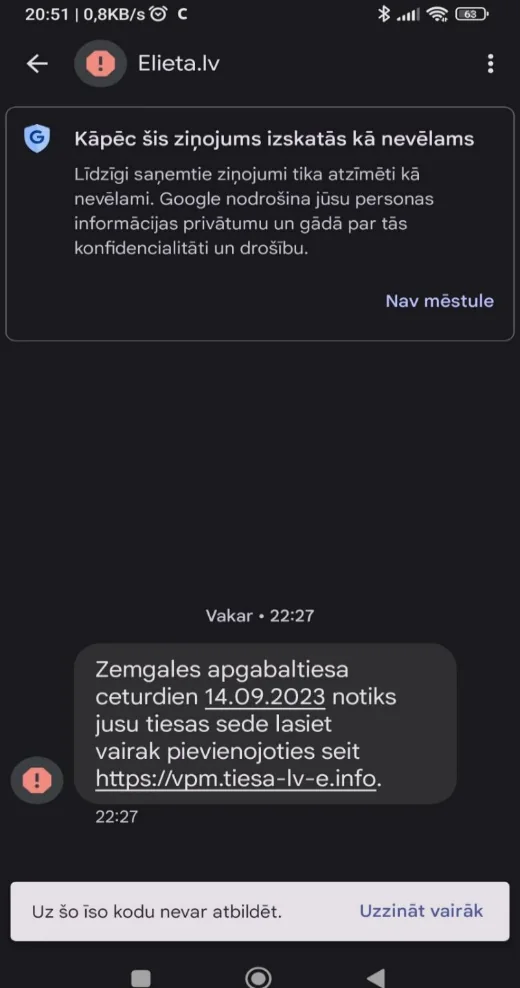
For example, at the beginning of 2023, IT security services noticed a smishing campaign that supposedly notified recipients of a court summons (see Figure 1). A message asking you to appear in court will in most cases cause alarm and an urge to act immediately — to click the link to find out more.
Let’s look at the attack in more detail!
- The link starts with the abbreviation “vpm”, which is associated with the “single sign-on module” (vienotās pieteikšanās modulis), a shared government service used to identify website visitors.
- Clicking the link makes it clear that delivering information was not the main purpose of the message — the user is immediately asked for bank details (see Figure 2). This means the fraudster’s aim was to steal money.
- This particular platform offers the ability to steal both e-mail credentials and bank details. The harvested data can be sent automatically with this tool — via Telegram, by e-mail — or saved manually.
Figure 2. An opened smishing link
How are fraudulent campaigns built? Conclusions
This fraudulent content management system (CMS) can mostly be bought by anyone, or used as a PhaaS (phishing-as-a-service) offering.
We examined various websites that have come to media attention in connection with fraud cases, including:
vpm[.]tiesa-lv-e[.]info
lv-pieslegties[.]net
test[.]vpm-viss-lv[.]info
lv-pievienoties[.]info
vpm[.]gov-lv[.]info
gov[.]vpm-viss-lv[.]net
vpmviss[.]tiesas-lv[.]info
vp[.]kriminallieta-2466654[.]net
vpm[.]viss-tiesas[.]lat
The platform’s authors have also taken care of the attackers’ comfort and safety — before luring victims and launching fraudulent campaigns, fraudsters can practise their malicious intentions on various test pages, including, for example:
www[.]accessify[.]com/h/haamegujarati[.]com
sites[.]ipaddress[.]com/www[.]banka[.]lukb-digital[.]com
sites[.]ipaddress[.]com/stgeorgeclient-login[.]com
sites[.]ipaddress[.]com/login-secureweb[.]com
How to protect yourself from online fraud?
Online fraudsters are often experienced and know exactly which “buttons” to press so that the less protected and less informed part of society, overcome by alarm and anxiety, gives in to the urge to visit fraudulent websites. That is why it is essential to stay vigilant. A few tips:
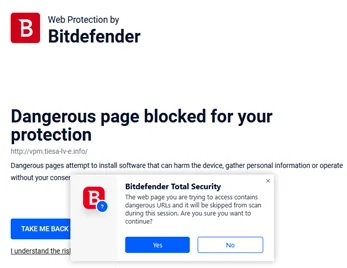
Buy an antivirus (a family package) and install it on all your digital devices. Many antivirus programs also include protection against phishing. For example, when you open such a site on a computer protected by an antivirus system, you will receive a warning about the security threat (see Figure 6).
Call your older relatives and talk from time to time about the latest types of fraud. Many people who have never encountered fraud schemes think “this will never happen to me” — until, suddenly, it does.
Follow trusted sources of information on their websites and social networks. When in doubt, it is also worth keeping in mind the CERT.LV DNS firewall (see here) — a free tool that protects individual users and organisations from cyber threats such as fake bank pages, fraudulent trading platforms and sites that spread malware.
Don’t stay indifferent: if you notice a malicious website copying a popular .LV website, report it. You can read about how to report on pardrosibu.lv, in the article “What to do if you spot a malicious .LV website?” (in Latvian).
Take care of your own and your loved ones’ safety! And if you found this article useful, we would appreciate a “Like” and a share with someone who would benefit from reading it.
About us
VersaIntel is a young IT security and digitalisation company focused on proactive action in strengthening clients’ cyber resilience and digitalisation. We want the next phishing attempt to remain just an attempt — something colleagues can discuss over a cup of coffee.
VersaIntel is part of the ZEVS full-spectrum security group.
Photo by Sora Shimazaki: https://www.pexels.com/photo/judges-desk-with-gavel-and-scales-5669619/